

Choosing your first proprietary trading firm can feel overwhelming. Providers advertise different account sizes, evaluation challenges, profit splits, trading platforms, and payout schedules, often making their programs look easier to compare than they really are. For a beginner, the most important question is not which firm promises the biggest account. It is which program offers rules you can understand, costs you can afford, and trading conditions that fit your current experience.
A prop firm evaluation typically tests whether a trader can meet defined performance objectives while staying within risk limits. Depending on the program, traders may use simulated accounts and become eligible for rewards after satisfying additional conditions. Passing an evaluation is not guaranteed, and paying for a challenge should never be treated as a shortcut to reliable income.
This guide compares ten options worth researching, explains the features beginners should prioritize, and provides a practical checklist for making a more informed decision.
Ten Prop Firms to Consider as a Beginner
The firms below represent different approaches to proprietary trading, including forex and CFD evaluations and futures-focused programs. The order is an editorial comparison for this guide, not a guarantee of quality, payout reliability, or suitability for every trader. Product availability and challenge conditions can change, so confirm the current rules before purchasing.
| Rank | Prop Firm | Best For | Markets | Challenge Types | Editorial Rating |
|---|---|---|---|---|---|
| 1 | FTMO | Beginners who want a structured evaluation process | Forex and CFDs | 1-Step, 2-Step | 9.6/10 |
| 2 | The5ers | Traders interested in progression and scaling | Forex and CFDs | Multiple evaluation paths | 9.4/10 |
| 3 | Leofins | New traders comparing different evaluation formats | CFDs and a separate futures offering | Core 2-Step, Edge 1-Step, Starter 3-Step; futures program | 9.2/10 |
| 4 | FundingPips | Comparing different challenge structures | Forex and CFDs | Multiple models, depending on availability | 9.0/10 |
| 5 | FundedNext | Traders comparing evaluation and reward structures | Forex and CFDs; check current product availability | Multiple models | 8.9/10 |
| 6 | Topstep | Beginners specifically interested in futures | Futures | Trading Combine | 8.8/10 |
| 7 | Take Profit Trader | Futures traders comparing evaluation conditions | Futures | Test evaluation | 8.6/10 |
| 8 | Earn2Trade | Futures traders who value structured learning pathways | Futures | Career Path, Gauntlet pathways; verify current availability | 8.5/10 |
| 9 | Tradeify | Futures traders comparing account models | Futures | Multiple plans; verify current options | 8.3/10 |
| 10 | My Funded Futures | Futures traders comparing entry-level programs | Futures | Multiple plans; verify current options | 8.2/10 |
The editorial ratings are comparative judgments for this article, not independent statistical measures. They should not replace your own assessment of a firm’s current terms.
A beginner should not feel obliged to choose the highest-ranked option. If you only trade futures, a futures-specific provider may be more relevant than a CFD firm. If you are still learning how to control risk, the best next step may be to practise on a demo account before paying for any evaluation.
What Makes a Prop Firm Suitable for Your First Challenge?
Experienced traders may be comfortable interpreting complicated rulebooks, but beginners benefit from programs whose essential conditions are transparent. Before comparing marketing claims, focus on five fundamentals.
Clear and understandable risk rules
Start with the daily loss limit and maximum drawdown. These determine how much the account can lose before a breach occurs, but the calculation methods vary between providers.
A daily loss limit may depend on the day’s starting balance or equity, and some rules include unrealized losses on open positions. Maximum drawdown may be static or trailing. Those differences can affect whether a trading strategy is viable under a particular program.
Before purchasing, establish:
- How daily losses are calculated.
- Whether open-position losses count toward the limit.
- Whether the maximum drawdown remains fixed or moves with account performance.
- When daily limits reset and which time zone applies.
- What happens after a breach.
If you cannot explain the rules in your own words, pause before paying. Understanding the boundaries is part of the challenge itself.
A realistic evaluation target
Evaluation targets should be assessed alongside the loss limits. A target may appear achievable in isolation, but reaching it while respecting a tight drawdown limit can require a very different approach.
Beginners should avoid increasing position sizes simply to reach a target faster. Instead, consider whether your existing strategy has a realistic chance of meeting the objective without changing your risk habits.
Also check the required number of trading days, whether there is a maximum evaluation period, and whether consistency conditions apply. The number of stages alone does not determine how difficult a challenge will be.
Affordable entry costs
The fee is one of the clearest risks of buying an evaluation: if you fail or breach the rules, you may lose the amount paid. Treat the fee as money that may not be recovered.
Compare the total cost rather than the headline discount. Check whether the program has recurring subscriptions, activation charges, optional upgrades, or conditions attached to fee refunds.
A beginner should never borrow money or use funds needed for rent, food, bills, or other essential expenses to buy a challenge. There is no guarantee that an evaluation will be passed or that future rewards will cover the fee.
Transparent payout conditions
A profit split is only one part of a program’s reward structure. First-payout timing, minimum withdrawal requirements, consistency rules, caps, and eligibility conditions can be equally important.
Look for precise answers to these questions:
- When can the first payout be requested?
- Are there minimum trading-day requirements?
- Is there a minimum withdrawal amount?
- Do profit caps or consistency rules apply?
- Are the conditions different for later payouts?
- What documentation or verification is required?
Do not rely solely on advertising that uses phrases such as “fast payouts” or “high profit split.” Read the rules that apply to the exact account you plan to purchase.
A platform and market you already understand
Beginners should generally avoid learning a new market, unfamiliar software, and a restrictive evaluation format at the same time.
If you practise on MetaTrader, check whether the chosen program supports the platform and instruments you need. If you trade futures, make sure you understand contract sizes, tick values, session schedules, and position limits before entering an evaluation.
Familiarity will not guarantee success, but it can reduce avoidable mistakes caused by unfamiliar tools or market mechanics.
The Ten Options: What Beginners Should Compare
1. FTMO — A structured evaluation process
FTMO is worth researching if you want a clearly defined evaluation with published objectives. Its two-step challenge separates the assessment into two phases, while a one-step option is also available. The rules differ by product, so do not assume the same drawdown limits apply to both.
For a first challenge, pay particular attention to how the daily loss limit is calculated, how open-position losses are treated, and whether consistency requirements apply to the selected account. FTMO also provides educational resources that may help traders understand evaluation concepts, although these resources cannot replace practice and risk management.
Best question to ask: Can your existing strategy meet the objectives without increasing your usual risk per trade?
2. The5ers — Multiple paths for progression
The5ers is another provider to consider when comparing evaluation structures and progression opportunities. Its different programs are designed around different trading approaches, so the most important step is identifying the exact program rather than judging the brand as a whole.
Check the requirements for moving between account stages, the applicable loss limits, and the conditions governing rewards. If you plan to hold positions overnight or trade during major news events, verify the current restrictions for your selected account.
Best question to ask: Do the program’s progression rules reward the way you trade, or would you need to change your strategy substantially?
3. Leofins — Several evaluation formats to compare
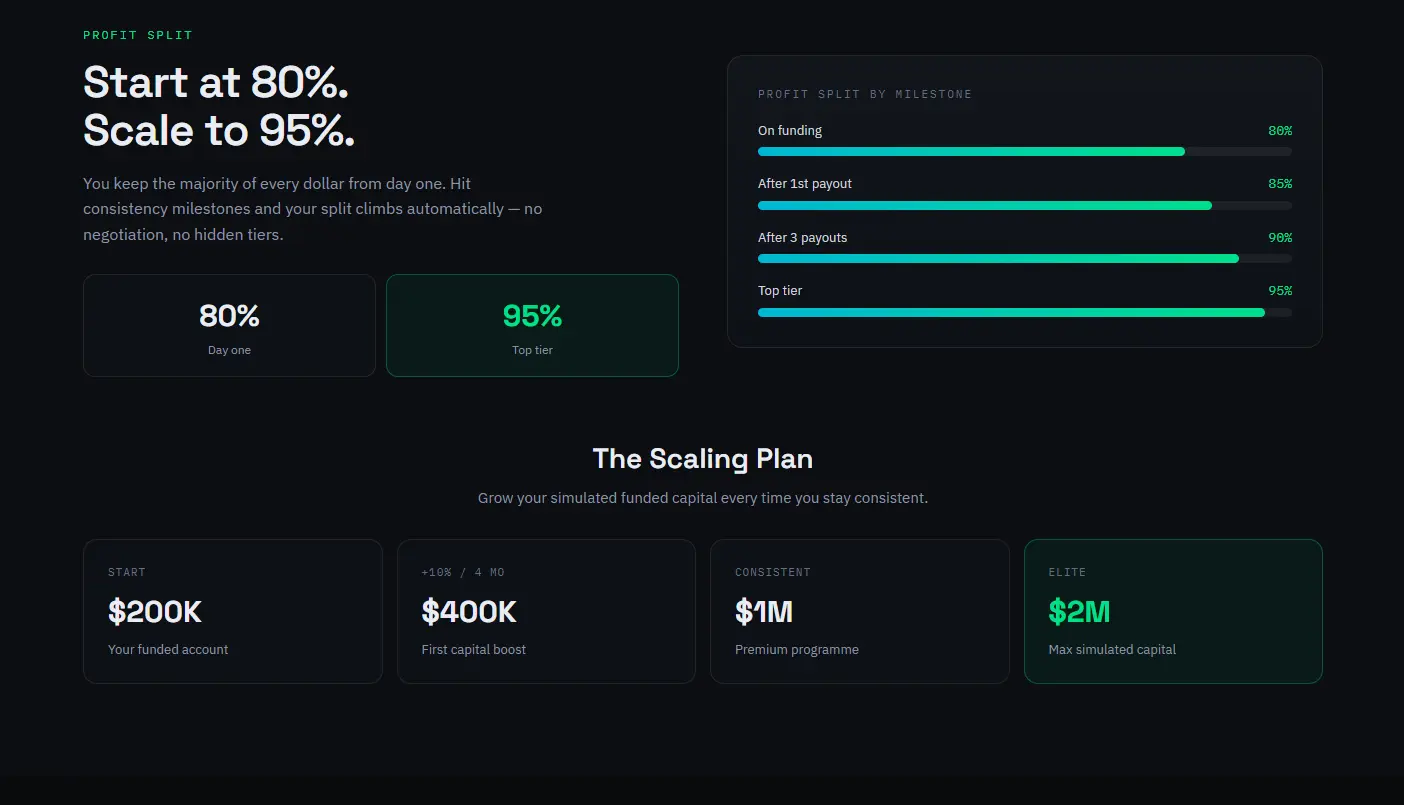 Leofins offers three CFD evaluation structures: Core 2-Step, Edge 1-Step, and Starter 3-Step. It also has a separate futures-oriented offering, which should be assessed independently from its CFD programs.
The Core model uses two evaluation phases, while Edge has a single evaluation phase and Starter uses three. These differences affect how the evaluation is organized, but the number of stages alone does not establish which option is easiest. Targets, drawdown limits, minimum trading days, and payout conditions all matter.
New traders can review the current programs at www.leofins.com/. Compare the complete rules for each model before selecting one, especially if you are still developing consistent position sizing and stop-loss habits.
Best question to ask: Which program can you follow without changing your risk management just to reach its target?
4. FundingPips — Different challenge models
FundingPips offers several account models with different evaluation phases, profit targets, and loss limits. That variety can be useful for comparing structures, but it also means beginners need to read the specific rules for the chosen model carefully.
Compare the daily and overall loss limits, minimum trading days, reward arrangements, and any model-specific risk restrictions. Check the payout rules for the post-evaluation account as well as the requirements for passing the challenge.
Best question to ask: Have you compared the complete rule set for your preferred model, rather than only its fee and profit target?
5. FundedNext — Comparing evaluation and reward structures
FundedNext offers multiple CFD challenge formats, including one-step and two-step options and other program variants. Each has its own combination of targets, account conditions, and reward arrangements.
For beginners, the practical choice depends on how the evaluation requirements match their established strategy. A one-step model is not automatically easier, and a lower entry fee does not necessarily mean better value if the conditions are a poor fit.
Check the minimum trading requirements, applicable drawdown rules, reward eligibility, and any conditions tied to fee refunds. Confirm the current program details before checkout.
Best question to ask: Which model gives you a realistic opportunity to demonstrate your existing strategy within the stated risk limits?
6. Topstep — A futures-focused option
Topstep is relevant for traders who want to specialize in futures rather than forex or CFDs. Its Trading Combine assesses performance against defined objectives and a Maximum Loss Limit, and its rules include a consistency target.
Futures trading requires familiarity with contract specifications, tick values, trading hours, and position limits. Beginners should understand these mechanics before paying for an evaluation. They should also account for subscription costs and review the current conditions for progressing from the Trading Combine to a funded stage.
Best question to ask: Do you understand the futures contracts and position limits well enough to trade them without relying on guesswork?
7. Take Profit Trader — Futures evaluation rules
Take Profit Trader is another futures-oriented provider to investigate. Its Test evaluation has defined profit objectives, position limits, end-of-day drawdown rules, and consistency requirements.
Do not focus on one feature in isolation. A rule that appears flexible may be accompanied by another condition that affects your trading style or eligibility for rewards. Review the Test rules and the conditions that apply after passing, because evaluation and subsequent account stages may not operate identically.
Best question to ask: Can you explain the drawdown and consistency rules, including how they affect your trading decisions?
8. Earn2Trade — Structured futures pathways
Earn2Trade provides futures evaluation pathways, including Trader Career Path and Gauntlet Mini. These programs have defined requirements around loss limits, position sizes, permitted trading times, and consistency.
That structure may appeal to traders who prefer clearly specified objectives. However, rules can be demanding for beginners who have not yet developed consistent risk control. Review the current minimum requirements and the conditions that apply to the particular pathway you are considering.
Best question to ask: Can your normal position sizes and trading schedule comply with the program’s limits?
9. Tradeify — Compare available futures plans
Tradeify is worth researching if your focus is futures and you want to compare different account structures. Before choosing a plan, review its current evaluation objectives, drawdown calculations, contract limits, and payout conditions.
Avoid assuming that all plans from one provider have identical rules. Account options can differ in their risk parameters, costs, and eligibility requirements, so the precise product matters more than the general brand description.
Best question to ask: What are the full costs and withdrawal requirements of the exact plan you intend to purchase?
10. My Funded Futures — Another option for futures traders
My Funded Futures is another provider to include in a futures comparison. Its available plans and conditions should be checked directly before you commit to an evaluation.
Look beyond advertised account size and consider the contract limits, drawdown rules, fees, and requirements for requesting rewards. If you are new to futures, first make sure that you can calculate the monetary risk of each contract and understand how the program measures losses.
Best question to ask: Does the plan allow you to trade your strategy at a position size that keeps risk within your personal limits?
One-Step vs. Two-Step Challenges: Which Should Beginners Choose?
The number of evaluation phases is a useful comparison point, but it should not determine your decision by itself.
A one-step challenge typically asks the trader to meet the evaluation objective in one phase. This can make the process easier to understand, but the target, drawdown allowance, and other rules may be different from those of a multi-step program.
A two-step challenge separates the evaluation into two phases, often with different profit targets. It gives the trader more than one stage to complete, but both phases must be passed while following their respective rules.
A three-step challenge divides the evaluation into more stages. That does not automatically make it more forgiving: the combined objectives, minimum trading days, and account conditions still determine how demanding it is.
For beginners, the best comparison is not “one step versus two steps” in isolation. Instead, write down the target, daily loss limit, maximum drawdown, minimum trading days, time limit, and total fee for each model. Compare the figures and calculation methods side by side.
Common Mistakes First-Time Prop Traders Make
Choosing the biggest account
A large advertised account can create unrealistic expectations. The amount shown is generally a nominal or simulated account size, not cash you can freely withdraw. Your actual trading flexibility is governed by the program’s loss limits and other rules.
Start with a program you can understand and afford. Do not select a larger account merely because the advertised reward potential looks more impressive.
Trading more aggressively to pass faster
Trying to complete an evaluation in the shortest possible time can encourage oversized positions, excessive trading, and emotional decisions. If your strategy requires taking risks that you would normally avoid, the challenge may not be a suitable fit.
Use a consistent risk plan and let the evaluation’s rules determine the boundaries. Do not increase risk simply because you are behind your target.
Ignoring the post-evaluation conditions
Passing an evaluation does not mean that every subsequent condition disappears. The next stage may have its own loss limits, consistency requirements, payout schedule, and other rules.
Read the terms for both the evaluation and the account that follows it. Make sure you understand how rewards are calculated and when you become eligible to request a withdrawal.
Buying repeated challenges without reviewing the cause of failure
If you breach a rule, identify the reason before purchasing another attempt. Was the loss limit misunderstood? Was position sizing too large? Did a news event, overnight position, or emotional decision affect the result?
Without a review process, repeated fees can accumulate while the underlying problem remains unchanged. Consider practising on a demo account until you can follow your trading plan consistently.
Trusting promotional claims without reading the terms
Marketing pages may emphasize profit splits, account sizes, or payout speed. Those details matter, but they do not replace the official program rules.
Check the terms that apply to your exact account and save a copy for reference. If something is unclear, ask the provider for clarification before paying.
A Beginner’s Checklist Before Paying for a Challenge
Use this checklist to compare your shortlist:
I know which market I want to trade: forex, CFDs, or futures.
The platform and instruments match my current experience.
I understand the daily loss and maximum drawdown calculations.
I know whether unrealized losses count toward risk limits.
The profit target is realistic for my strategy and position sizing.
I understand the minimum trading days and any time limits.
The rules for overnight, weekend, and news trading are clear.
I have reviewed the payout requirements, consistency rules, and any caps.
I know the complete cost, including subscriptions or additional charges.
I can afford to lose the evaluation fee without affecting essential expenses.
I have practised the strategy and risk plan before attempting the challenge.
If you cannot confidently check every important item, take more time to research or practise. There is no need to rush into an evaluation.
Frequently Asked Questions
Do I need to be profitable before joining a prop firm?
You should have a tested strategy and a clear understanding of risk before paying for a challenge. A prop firm evaluation is not a substitute for learning how to trade. Practising on a demo account can help you identify weaknesses without repeatedly spending money on evaluation fees.
Which prop firm is easiest for beginners?
There is no universally easiest firm. The difficulty depends on the evaluation targets, loss limits, minimum trading requirements, consistency rules, and your own strategy. A program that works for an intraday forex trader may be unsuitable for a futures trader or someone who holds positions for several days.
Should I choose a challenge based on the profit split?
No. A high advertised split does not guarantee that you will qualify for rewards or receive a payout. Consider the split alongside the fee, risk limits, evaluation requirements, and withdrawal conditions.
Are prop firm accounts funded with real money?
Many proprietary trading programs use simulated evaluation accounts and may continue using simulated environments after a trader passes. The exact structure varies by provider and program. Read the relevant agreement to understand how trading is conducted and how performance-based rewards are paid.
How much should I spend on my first challenge?
Only consider a fee that you can afford to lose in full. There is no guarantee of passing an evaluation, and buying repeated attempts can become expensive. Set a firm budget before comparing account sizes or promotional offers.
Can I switch prop firms if the first one is unsuitable?
You can research other providers, but avoid immediately purchasing another challenge after a disappointing result. First identify what went wrong, review your trading records, and determine whether the problem was your strategy, risk management, or a mismatch with the program rules.
Make Your First Choice a Measured One
Your first prop firm should be selected on compatibility, not hype. Begin with the market you understand, compare the complete rules for each evaluation, and make sure the fee fits your budget. The most suitable program is one whose risk limits and trading conditions allow you to follow a disciplined strategy without forcing you to take unnecessary risks.
Take time to practise before purchasing, read the current terms carefully, and treat the evaluation as a demanding assessment rather than a guaranteed route to income. A careful decision cannot ensure success, but it can help you avoid paying for a challenge that does not suit your experience.
Prices and conditions are current as of October 2026.
Risk disclaimer: Proprietary trading evaluations involve financial risk. Challenge fees may be lost if an evaluation is unsuccessful or program rules are breached. Simulated trading and funded-program results do not guarantee future performance or income. Review the current terms carefully and never spend money you cannot afford to lose.